Your friend’s toddler is already saying “Mommy, look, a big dog!” while your child of the same age points, grins, and says “da!” It is one of the most common worries we hear from Chicago parents: is my toddler a late talker? The good news is that speech develops on a wide timeline, and many late talkers catch up. The important part is knowing which signs are normal variety and which ones mean it is time for a closer look. This guide walks you through speech milestones by age, the red flags to watch for, what bilingual families should know, and how to help your toddler talk more at home.
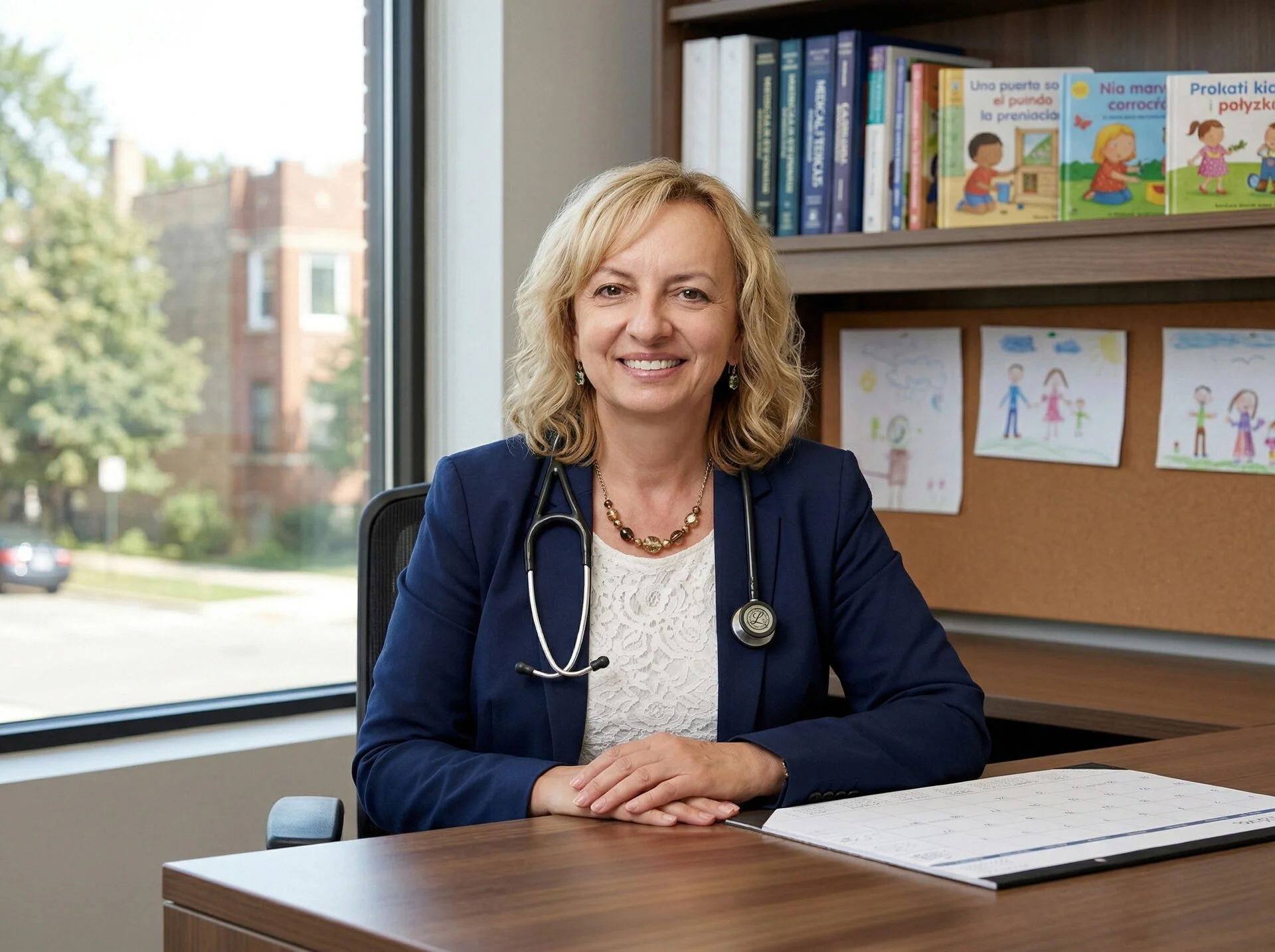
At ASB Medical Clinic on Irving Park Road, Dr. Anna Banas has followed the speech and language development of Chicago children since 1994, many of them growing up with Polish, Spanish, or Russian at home.
What Is a “Late Talker”?
A late talker is a toddler, usually between 18 and 30 months, who says fewer words than expected for their age but is developing well in other ways. These children often understand a lot, play with toys in meaningful ways, use gestures, and connect warmly with the people around them. They just are not saying much yet.
Many late talkers catch up on their own by the time they start school. Some do not, and it is hard to tell early on which children will need help. That is why “wait and see” is not the best plan. A quick check with your pediatrician costs nothing but a short visit, and starting support early can make a real difference if your child needs it.
It also helps to know that late talking can be the first visible sign of something else, such as hearing loss, a broader developmental delay, or autism. In most cases it is not, but those possibilities are why a screening matters.
Speech and Language Milestones by Age
The CDC’s Learn the Signs. Act Early. program lists milestones that most children (75% or more) reach by each age. If your child has not reached a milestone yet, that does not automatically mean a delay. It does mean it is worth mentioning at the next visit.
| Age | What most children do |
|---|---|
| 12 months | Waves “bye-bye,” calls a parent “mama,” “dada,” or another special name, and understands “no” |
| 15 months | Tries to say one or two words besides “mama” or “dada,” and points to ask for something |
| 18 months | Tries to say three or more words besides “mama” or “dada,” and follows simple one-step directions |
| 2 years | Says at least two words together, like “More milk,” and points to things in a book when you ask |
| 30 months | Says about 50 words and puts two or more words together with an action word, like “Doggie run” |
| 3 years | Talks with you in a conversation with at least two back-and-forth exchanges and asks “who,” “what,” “where,” or “why” questions |
Remember that these are not averages. They are what most children can already do by that age. A child who is right at the edge of a milestone is often fine. A child who is clearly behind on several milestones should be checked.
Understanding Words Matters as Much as Saying Them
Speech is only part of the picture. Pediatricians and speech therapists also look at receptive language, which is how much your child understands. A toddler who says only a few words but follows directions, points to pictures when you name them, and brings you their shoes when you ask is in a very different situation from a toddler who does not seem to understand.
Watch for these signs of strong understanding and communication:
- Looks at familiar objects or people when you name them
- Follows simple directions like “Give me the ball” without gestures
- Uses gestures such as pointing, waving, nodding, or shaking the head
- Brings toys to show you, not just to get help
- Copies sounds, words, and actions
Children who understand well, use gestures, and engage with people tend to have the best chance of catching up on their own. Even so, they deserve a check if they are behind.
Red Flags: When to Call Your Pediatrician
Trust your instincts. You know your child best, and you never need to wait for a scheduled checkup to raise a concern. Call our office at (773) 777-4767 if your child:
- Does not babble or respond to sounds by 9 months
- Does not point, wave, or use other gestures by 12 to 15 months
- Says no words besides “mama” or “dada” by 15 to 18 months
- Does not put two words together by 2 years
- Does not seem to understand simple words or directions
- Does not respond to their name or rarely makes eye contact
- Is very hard to understand for family members by age 3
- Loses words or skills they used to have, at any age
Losing skills is always a reason to call right away. It is uncommon, but it is the one sign that should never wait.
Growing Up Bilingual: Does It Cause a Speech Delay?
Many families in Portage Park, Dunning, and Irving Park speak Polish, Spanish, Russian, or another language at home. Parents often ask us whether learning two languages slows down speech. The short answer is no. Bilingual children reach their first words and first word combinations within the same age range as children who learn one language.
A few things are normal for bilingual toddlers:
- Smaller vocabulary in each language. Count your child’s words in all languages together. “Milk” in English and “mleko” in Polish both count.
- Mixing languages in one sentence. This is a normal stage, not a sign of confusion.
- A quiet period. A child who starts daycare or preschool in a new language may talk less there for a while.
Keep speaking the language you are most comfortable with. Rich, natural conversation in your home language builds a strong base for learning English too. A true speech or language delay shows up in every language your child speaks, so if your child is behind in all of them, that is when to check in with us. At ASB, we can talk through your child’s development in English, Polish, Spanish, or Russian.
Check Hearing First
Children learn to talk by hearing speech clearly. Even a mild or temporary hearing problem can slow language. A passed newborn hearing screen is a great start, but hearing can change later.
One common cause in toddlers is fluid that stays behind the eardrum after repeated ear infections. It can muffle sounds for weeks or months. That is why a hearing check is one of the first steps we take when a toddler is talking late. If needed, we refer you to a Chicago audiologist or ear, nose, and throat specialist.
Everyday Ways to Help Your Toddler Talk More
You do not need special toys or programs. The best language teacher is a parent who talks, listens, and plays. Try these simple habits during the day:
- Narrate your routines. Describe what you are doing while you cook, dress your child, or ride the bus: “Now we put on your red boots.”
- Expand your child’s words. If your child says “milk,” answer with “You want more milk.” You model the next step without correcting.
- Pause and wait. After you ask a question or start a song, wait a few seconds. Give your child a chance to fill in the word.
- Read every day. Point to pictures, name them, and ask “Where is the dog?” Let your child turn the pages.
- Offer choices. “Apple or banana?” invites your child to use a word instead of a gesture.
- Sing and rhyme. Repetition in songs makes words easier to remember and say.
- Limit screens. The American Academy of Pediatrics advises avoiding screen media other than video chatting for children younger than 18 months, and about one hour a day of high-quality programs for ages 2 to 5, ideally watched together.
Chicago winters keep families indoors for months, which can mean more screen time. Indoor play, library story times, and park district programs are great ways to keep conversations going all year.
How a Developmental Screening Works at ASB
A developmental screening is a short, structured check of how your child talks, understands, moves, and plays. The American Academy of Pediatrics recommends developmental screening at 9, 18, and 30 months, and autism screening at 18 and 24 months. We build these checks into your child’s routine well-child examinations, and we can screen sooner if you have a concern.
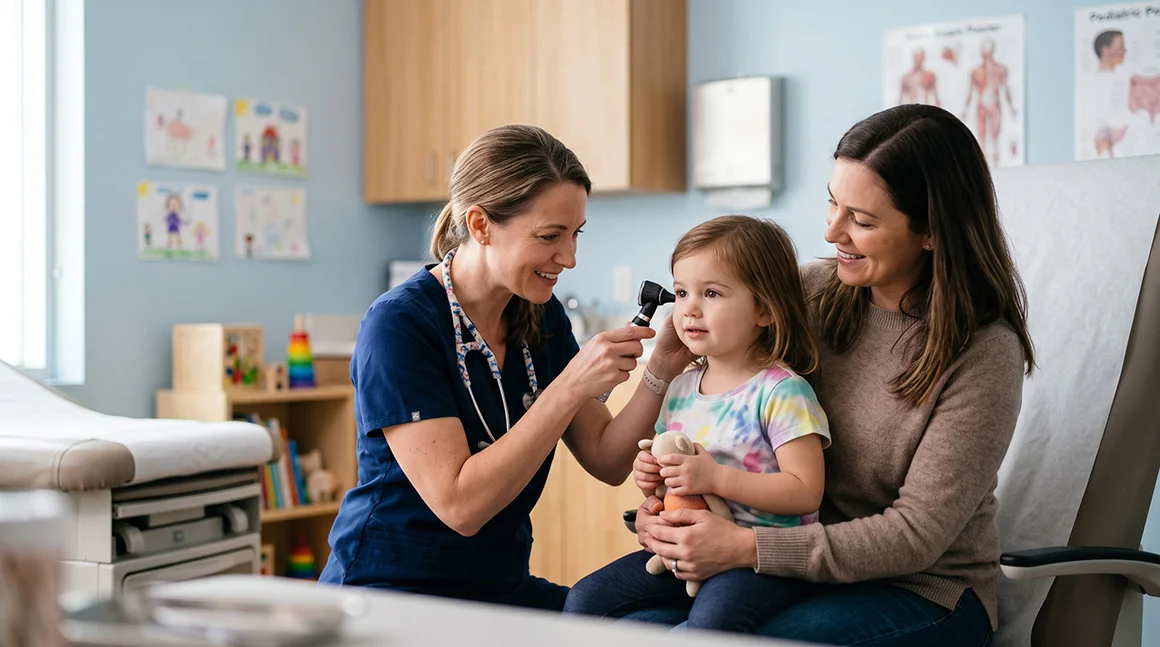
During a visit, we ask what your child does at home, watch your child play and communicate, compare skills with age milestones, and check hearing when needed. Then we explain the results in plain words and agree on next steps together. Learn more on our developmental screenings page.
Early Intervention in Illinois: Free Help Before Age 3
If your child is younger than 3 and has a speech or other developmental delay, they may qualify for Illinois Early Intervention. The program starts with a free evaluation and can include speech therapy and other services, often at home or in daycare. Families get started through a local Child and Family Connections office. The Illinois Department of Early Childhood explains the process.
Children who are 3 or older are evaluated through the public school district instead, which for most of our families means Chicago Public Schools. We help with referrals in both cases and share your child’s records, so you do not have to repeat the whole history.
How ASB Medical Clinic Helps Families With Late Talkers
ASB Medical Clinic is a private pediatric practice at 6033 Irving Park Rd, Chicago, IL 60634. Dr. Anna Banas has cared for Chicago children from birth through the teen years since 1994. When parents are worried about speech, we offer:
- Developmental and autism screenings at well-child visits, or sooner if you are concerned
- Hearing checks and follow-up for ear fluid
- Referrals to Illinois Early Intervention, speech therapists, and Chicago specialists
- Clear guidance for bilingual families
- Visits in English, Polish, Spanish, and Russian
Our office hours are Monday through Friday, 9 AM to 5 PM, and two Saturdays each month, 9 AM to 5 PM. Call (773) 777-4767 or request an appointment online.
Frequently Asked Questions
At what age should a toddler say their first words?
Most children say their first words around 12 months, and by 15 months most try to say one or two words besides “mama” or “dada.” By 18 months, most try to say three or more words.
How many words should a 2-year-old say?
By 2 years, most children put at least two words together, like “more milk.” By 30 months, most say about 50 words.
Should I wait and see if my late talker catches up?
No, it is better to check early. Many late talkers catch up, but a screening shows whether your child needs support, and early help works best.
Does speaking two languages cause a speech delay?
No, bilingual children reach early speech milestones in the same age range as other children. Count words in all languages together when you track progress.
Can screen time delay my toddler’s speech?
Screens take time away from talking and playing with people, which is how toddlers learn language. The AAP advises avoiding screens other than video chat before 18 months and limiting them to about one hour a day for ages 2 to 5.
Do boys talk later than girls?
On average, boys may start talking a little later, but the same milestones apply. A boy who is clearly behind should be checked, not dismissed.
Every child finds their voice at their own pace, but you do not have to guess alone. If you are wondering whether your toddler is a late talker, a short visit can give you clear answers and a plan. Our team is here to help.
This article is for informational purposes only and does not constitute medical advice.